We’ve Entered the Era Where Competence Is a Red Flag
Congratulations on your coherent sentence structure. Unfortunately, that’s suspicious.
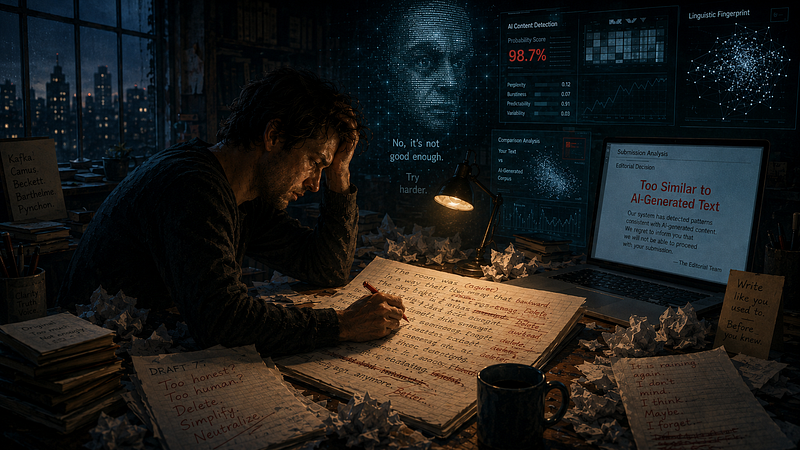
There’s a new rule nobody announced but everybody’s enforcing: if your writing is too clean, too structured, too coherent, you’re suspicious. If your sentences flow well and your points connect logically and you didn’t accidentally leave in a weird tangent about your aunt’s casserole, congratulations. You write like a robot. Please revise accordingly.
We’ve entered the era where competence is a red flag.
It happened quietly, the way most awful things do. AI-generated content flooded the internet. Platforms panicked. Publications started running submissions through detection tools with names that sound like they were designed to find war criminals. And somewhere in the middle of all that, actual human writers got caught in the crossfire, penalized not for being robots, but for having the audacity to edit their work.
The Part Where It Gets Stupid
Here’s what the algorithm is actually measuring: patterns. Sentence length variation. Transition phrases. Structural consistency. The problem is, those are also just… things good writers do. Things we were taught to do. Things we spent years learning to do without thinking about it.
So now the skill is the problem.
You spent a decade learning to write clean, purposeful sentences? Too bad. That’s an AI behavior now. You learned how to structure an argument so it builds on itself? Suspicious. You edited out your rambling tangents and spent twenty minutes moving commas around like they were load-bearing structural elements? Honestly, how dare you.
The solution, apparently, is to write worse. Not dramatically worse, just human worse. Throw in a sentence fragment for no reason. Let a paragraph run a little long and then just kind of… end it before you meant to. Use “anyway” as a transition. Contradict yourself mildly somewhere in the middle. Start a sentence with “Look.”
Look, I’m not kidding.
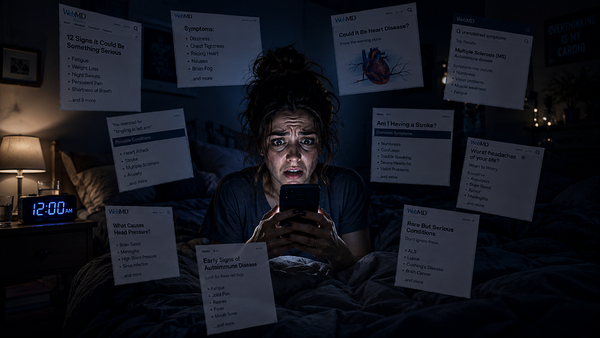
The advice circulating in writing communities right now is essentially: inject controlled chaos into your work so a machine believes a person made it. Which is the most dystopian sentence I’ve ever written, and I once wrote a piece about a WebMD spiral at midnight while fully convincing myself I had a rare neurological disorder.
What We’ve Actually Lost
What nobody’s saying out loud is what this costs.
Writing is revision. It’s the process of taking something raw and emotional and messy and making it into something another person can actually receive. That’s the whole job. You feel something, you find words for it, and then you sand down the parts that get in the way of the feeling landing. The polish isn’t decoration. It’s the point.
AI didn’t steal that process. It just made it look suspicious.
Now every writer who was taught to care about craft is sitting with a finished piece, rereading it like it’s evidence in a trial, asking themselves: does this sound too good? Should I rough it up a little? Should I make it worse so a tool designed to catch shortcuts doesn’t mistake my effort for one?
We’re sandpapering our own work in reverse.
And the cruelest part is that AI will catch up. It already is. The detection tools are chasing a moving target, and the actual robots are getting better at sounding messy and human and imperfect, while the humans are being told to sound more robotic in their imperfection. We’re all converging in the middle, and the middle is a place where nothing means anything and nobody can tell who’s who anymore.
The Part Where It Gets Personal
I submitted a humor piece to a Medium publication recently after spending an embarrassing amount of time tweaking sentences nobody but me would ever notice. I’d written it, revised it, cleaned it up, the way you do when you actually care about something you made.
The rejection came back in that weirdly polite editor tone that somehow makes bad news feel pre-formatted: your writing is too similar to AI text.
I’ve been writing since before most of these tools existed. I’ve written through things that would make a content farm short-circuit. I wrote through early sobriety and grief and the kind of life experiences that don’t fit neatly into prompts. My voice is the most mine thing I own. And some tool looked at it and said: not human enough.
I’m not telling you this for sympathy. I’m telling you because I know I’m not the only one. There are writers everywhere right now eating rejections like this, people who spent years developing a voice, a style, a way of putting words together that’s distinctly theirs, being told their humanity doesn’t register.
That’s not a content moderation problem. That’s something worse.
I thought about making the piece messier, but there’s something deeply humiliating about trying to fail a robot’s vibe check on purpose.
And I genuinely don’t know how to feel about that.
Jen Marie writes about recovery, relationships, mental health, and the ongoing challenge of sounding human enough for the algorithm. Find more of her work and social channels at Beacons
Or 300 claps… ok, 3 will do, and maybe a coffee