Some Storms Cannot Be Reasoned With
Learning to Take Shelter
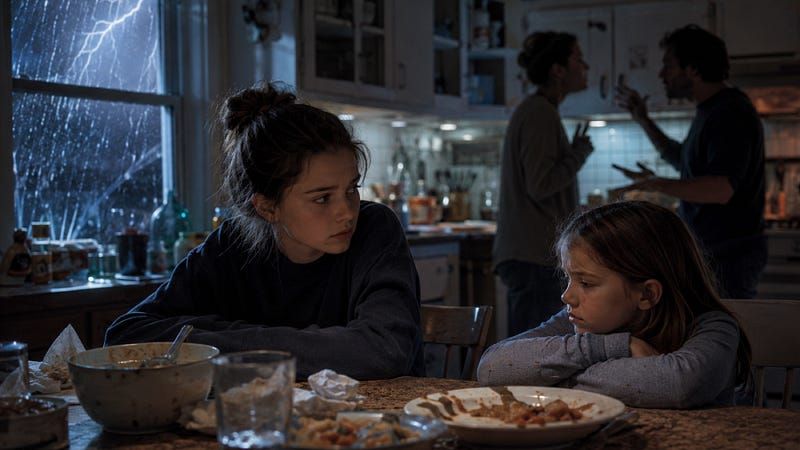
When my sister and I were growing up, we learned early that peace was not something you felt. It was something you managed.
Peace meant reading the room before you entered it. It meant listening to footsteps, the way a cabinet closed, the volume of a sigh. It meant knowing, almost instinctively, whether tonight would be safe or whether one wrong word could send everything crashing into chaos.
We knew what happened if we tried to explain what actually happened, if we challenged the truth that was handed to us. This parent was right. Always. Even when they weren’t. Especially when they weren’t.
There was hell to pay. Insults that cut deeper because they came from someone who was supposed to love us. Screaming that swallowed the whole house. Rage so irrational it made you question your own memory.
And eventually, the guilt would come. Reminders of everything she had done for us. Everything she sacrificed. Threats to block us, cut us off, disappear from our lives entirely. Accusations that we were ungrateful, selfish, cruel for even trying to explain our side of things.
Then, somehow, by morning, none of it had apparently happened at all.
“I don’t remember saying that.”
“That never happened.”
And so, the rest of us adjusted ourselves around the storm. We acted normal. We performed emotional CPR on the household. We made mood checks before speaking. We agreed quickly. We kept our heads down. We learned how to become smaller versions of ourselves in order to survive larger versions of someone else.
People looking in from the outside may have called us “good kids.” Respectful. Quiet. Easygoing.
What they didn’t see was that we were trained hostage negotiators in a family kitchen.
My father understood something I’m only now beginning to see: some storms cannot be reasoned with. You can’t negotiate with weather. So, he taught us how to take shelter. How to stay safe. How to wait it out. He’d catch my eye across the room and I’d know: not now. Wait. Let it pass. He was teaching us how to survive, and I loved him for it. He stayed when it would have been easier to leave, and he kept us as intact as he could. That was love. That was heroism.
Sometimes survival lessons do not look noble while they’re happening. Sometimes they look like silence. Like compliance. Like swallowing your own truth to avoid emotional shrapnel.
And children are adaptable. Terrifyingly adaptable.
You learn that honesty is dangerous. You learn that keeping the peace matters more than being understood. You learn that safety can disappear in a sentence. So, you become skilled at prevention. You anticipate moods before they fully form. You apologize when you’re not wrong. You smooth things over. You absorb tension like a sponge because somewhere deep inside your nervous system is the belief that conflict equals danger.
I’m 42 years old, and my chest still tightens when I hear a cabinet slam. My body still scans a room for shifts in tone before my brain has even registered what’s happening. I still carry this into certain relationships, especially the ones that feel familiar. The ones where love and unpredictability sit too close together. The ones where another person’s emotions take up all the oxygen in the room. The ones where speaking honestly feels less like communication and more like stepping onto a battlefield without armor.
And the frustrating part is this: the behavior works.
At least temporarily.
Keeping the peace often does protect you. It can stop escalation. It can prevent emotional explosions. It can buy safety for one more night, one more conversation, one more holiday dinner.
But eventually, something in you grows tired. Not dramatic. Not angry. Just tired. Tired of carrying the emotional weight of everyone else’s storms. Tired of pretending certain comments don’t sting. Tired of shrinking yourself to keep the atmosphere comfortable for other people.
Grief has a way of stripping things down to their truth. Loss changes your tolerance for chaos. It changes what your body is willing to carry.
My sister is gone now. She’s gone, and we lost years, years that should have been spent on closeness, on understanding each other without all the static. Years wasted navigating conflict and emotional landmines and distance that never should have existed in the first place. That’s the part that guts me. Not just that she’s gone, but that we lost so much time to survival when we could have had each other.
Some losses arrive all at once. Others happen slowly, over years, while everyone is busy surviving. And when someone you love is no longer here to speak for themselves, the silence can feel unbearably heavy. Sometimes grief is not only mourning the person you lost, but mourning the conversations, closeness, and peace that never fully had the chance to exist.
The peacekeeper eventually reaches a limit. Not because they stop loving people. Not because they become cruel. But because survival and self-erasure are not the same thing.
My sister’s passing changed something in me. Not immediately. But when the same patterns continued — when even grief became another storm to manage, when trying to protect someone I loved was still somehow twisted into proof of my cruelty — I realized something: peacekeeping had failed to keep us safe. It had only kept us quiet.
And I was done being quiet.
Back then, protection meant staying quiet, staying agreeable, staying emotionally alert at all times. Now, sometimes protection means distance. Sometimes it means saying less. Sometimes it means no longer volunteering yourself as emotional shelter during someone else’s storm.
I closed a door I never thought I’d close. Not out of hatred. Not even out of anger. Out of exhaustion. Out of the recognition that some people will make you the villain no matter what you do, and at a certain point, you have to stop trying to prove them wrong.
That was a hard lesson for me because keeping the peace has always felt safer than drawing a line. Boundaries can feel unnatural when you were raised to believe your role was to absorb impact.
But I am beginning to understand something important: protecting yourself is not the same thing as abandoning people.
It is not hatred to step out of the path of harm.
There are relationships where the cost of love is too high, and some people will never understand that unless they’ve paid it themselves.
People love to talk about unhealthy coping mechanisms as if they appear out of nowhere, as if human beings just wake up one morning and decide to betray themselves for fun. But some habits were built in emergencies. Some behaviors were survival tactics long before they became patterns.
You cannot shame someone for learning how to survive a war while they were still living in it.
That’s the part people miss. Children raised in emotional instability become experts in adaptation because they have to. They become translators, caretakers, emotional weather forecasters. They learn how to disappear without physically leaving. They learn that peacekeeping is sometimes the closest thing available to safety.
And even years later, long after the childhood home is gone, the body remembers. The body still flinches at raised voices. Still scans for shifts in tone. Still believes danger can arrive wearing the face of someone you love.
There is grief in realizing that what once protected you may now be following you into places it no longer belongs. But there is also compassion in understanding why it exists at all.
I was stubborn sometimes. I still am. Part of me kept trying to tell the truth even when it cost me. Even when it erupted into chaos. Even when it would’ve been easier to nod, apologize, and disappear.
Maybe that stubbornness was survival too.
Not all survival looks like silence. Sometimes survival is simply refusing to completely abandon yourself, even when peace would be easier.
“Quiet ain’t calm / sometimes it’s a cage… silence ain’t peace. Its just avoidance / Love doesn’t punish / It makes a choice / You call it calm / I call it control.” (Credit Georgia Phantom)